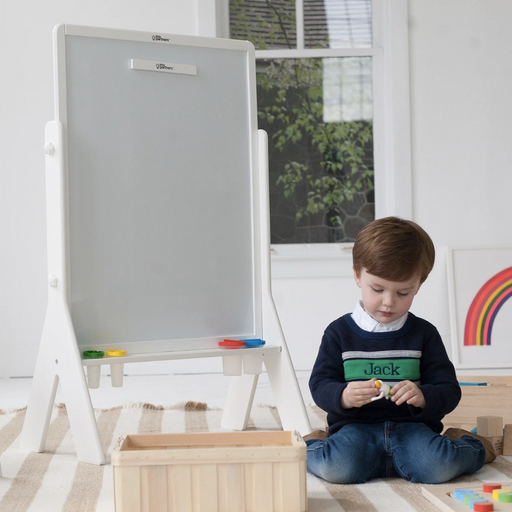
An easel brings the picture up in front of the child, leaving the surrounding space for brushes, chalk and colour. It can hold a sheet while a painting takes shape or offer a board for a drawing that changes throughout the afternoon. The surface provides a starting point; what appears on it is still the child's choice.
A drawing might become a sign for a pretend shop, a map of an invented place or a picture to give someone. These are different reasons to return to the same art setup. An easel doesn't need a planned project every time it comes out, and a reusable board doesn't need a finished picture to justify the activity.
Our range includes tabletop frames and freestanding easels, with paper-holding, chalkboard and whiteboard options. This fits My Playroom's approach to a prepared art space: offer usable materials and a clear place to work without deciding the subject in advance. The choice of surface helps connect that invitation with the kind of marks the child wants to make.
Paper, chalkboard or whiteboard?
Paper suits pictures you want to take away; a chalkboard or whiteboard suits marks that can be erased and changed. This is a useful distinction before comparing the frame. A drawing destined for the fridge needs a removable surface, whereas a pretend cafe menu can stay on the board and change with the next order.
Paper clips or holders keep the sheet in position. The usable board area and paper size affect how much room there is for the picture, especially when broad brush strokes reach towards the edges. A holder doesn't mean paper comes with every easel, so inclusions and refills are worth considering together.
A reusable board needs materials suited to its surface: chalk for a chalkboard, appropriate markers for a whiteboard. That keeps the decision connected to use rather than treating every drawing tool as interchangeable. Some formats offer more than one surface, making it possible to switch activities on the same frame.
For example, the Qtoys tabletop format combines board options with an acrylic insert for water-based painting. This is an additional way to work on that particular design, not a promise that every board can take paint. Our art materials provide the next choice to pair with the chosen surface.
Will a tabletop or freestanding easel suit your space?
A tabletop easel works with furniture you already have; a freestanding frame creates its own art position on the floor. The first can suit a room that needs to change uses, while the second can keep a drawing area ready between sessions.
With a tabletop design, the table height and the easel height work together. A small frame placed on a high dining table may still put the drawing area out of comfortable reach. The surface also needs room for the frame's depth and the supplies beside it, not just the width of the board.
A freestanding easel needs space around its legs and in front of the artwork. If both sides will be used, access behind the frame matters too. Two usable drawing faces can give two children separate pictures to work on, provided the room allows them both to stand and move.
Easels for kids serve a different purpose from a flat worktop. Cutting paper, making collages and spreading several craft materials can work better on a craft table. An easel can sit alongside that space for drawing and painting without needing to replace it.
Make the art area easy to use again
A small selection of reachable materials can be enough to begin: a few pieces of chalk beside the board, or paper and brushes near a painting surface. A tray or shelf, where the frame provides one, keeps tools close to the picture. A tabletop format can use nearby storage instead, leaving more of the table available for making.
Space for a wet picture matters as much as space for painting it. A sheet may need to stay on the holder while it dries, or move to another suitable surface before the board is used again. Keeping that step in mind makes the art corner useful beyond the moment the brush first touches the paper.
Storage depends on the frame. A tabletop easel can be moved off its work surface between activities, but it still needs a place that accommodates its shape. A floor frame may suit a lasting art corner. Folding, adjustment and outdoor use are individual features rather than things to assume from the word easel.
For a gift, the most useful pairing is often the easel and materials for one supported surface. Chalk, suitable markers or paper turn the frame into a ready activity, with further choices left open as interests change.