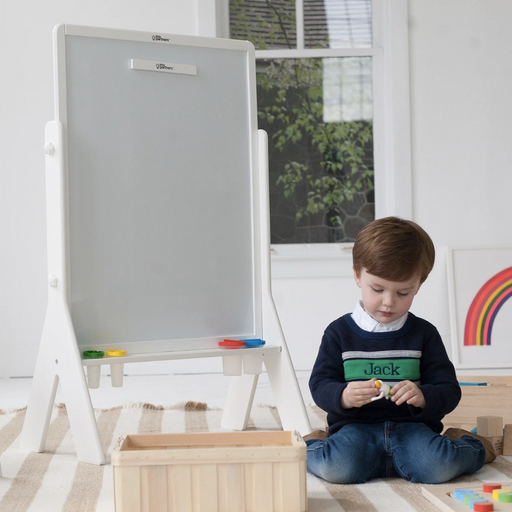
A blank board leaves plenty of room for a child's own ideas. One afternoon's picture might become a map, a collection of shapes or a sign for a pretend shop. With a reusable drawing surface, the activity can change as the story does, without every picture needing to become a finished piece of artwork.
Magnetic whiteboards add another way to work with those ideas. Suitable magnetic pieces can move around a drawing or sit beside a written word. A character can travel across a drawn landscape, or letters can form the name of the shop. The board offers a starting place without deciding what the child should make.
That flexibility is useful in a playroom, family area or early learning setting. The same surface can hold a quick drawing, a longer game or an idea two children are working on together. A few drawing materials and suitable pieces leave the subject open to the child.
Pictures That Can Change with the Game
A whiteboard suits drawings that are part of the activity happening now. A road can take a new turn, a face can gain a different expression, and a pretend restaurant can change its menu. Wiping away a few marks makes room for the next part of the game.
Drawing games are another reason to keep a reusable board close by. One person can sketch an animal for someone else to guess, add a detail to a shared picture or turn an unfinished shape into something unexpected. There's no single picture to copy and no need for everyone to draw the same thing.
Paper offers a different pleasure: a picture to give someone, put on the fridge or keep. A kids whiteboard can sit alongside those materials rather than replace them. For paintings, collages and drawings to save, our art and craft collection offers a wider starting point.
Bring Stories to Life with Magnetic Play
Movable pieces give a story another layer. A magnetic character can change places as the action moves on, while drawn paths, houses or trees create its surroundings. Instead of starting the whole picture again, children can rearrange the scene and try a different ending.
Shapes can become patterns, pictures or the pieces of an invented game. A row might alternate colours; a group of shapes might suggest a vehicle or an animal. The interest comes from placing and changing the pieces, with space left for children to decide what their arrangement means.
Magnetic describes the surface's ability to hold suitable magnetic pieces; it doesn't mean every magnetic toy will work equally well on every board. The board and the pieces need to be compatible. Drawing and magnetic play can share the same space when the surface also supports suitable whiteboard markers.
Make Room for Letters, Numbers and Everyday Ideas
A whiteboard for kids can hold early scribbles and later become a place for names, messages or simple games. A child might write a label for a toy shop, draw a shopping list or add numbers to a pretend scorecard. The marks have a purpose inside the play, without turning every drawing session into a lesson.
Compatible magnetic letters and numbers offer a different way to explore the same ideas. Letters can be moved into a name, and numbers can sit beside groups of drawn objects. Written marks and movable pieces allow different ways to take part, depending on the child's interests and the materials available.
The activity doesn't need to be complicated. A few symbols, a picture and a question can be enough to begin a conversation. As interests change, the subject on the board can change too, from an imaginary animal to the rules of a game someone has just invented.
A Shared Surface for Home and Early Learning
For one child, a board can be a place to develop an idea at their own pace. For shared play, it can hold a drawing to add to, a story to tell together or a game that takes turns. Different uses can follow one another on the same surface.
In a home or childcare setting, a familiar reusable board can give short activities a place between bigger projects. A group can gather around a drawn scene, suggest what happens next or leave a message for the next part of the game. Enough accessible drawing space helps everyone take part without needing to work over the same marks.
A magnetic board describes a surface and what it can do; an easel describes how a drawing surface is supported. For an upright art setup that may also hold paper or offer other drawing surfaces, explore our kids easels.